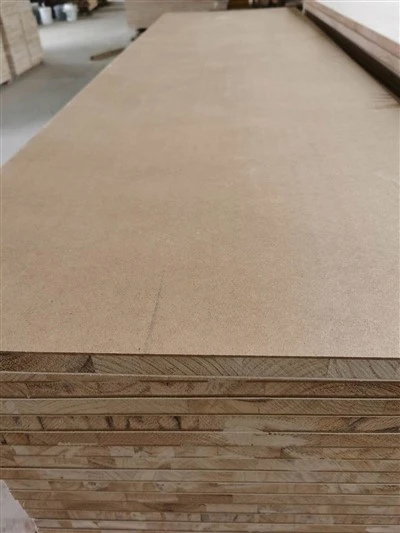
Since formaldehyde-based adhesives are generally used in the production of blockboard, the finished product will release free formaldehyde more or less. When the free formaldehyde content exceeds a certain limit, it will affect human health. The detection of the amount of formaldehyde released from the blockboard is a complicated process, and the formaldehyde emission of the blockboard is simply and preliminary determined by the following method. First, stack the unused blockboards in a small house, close the doors and windows, and store them for a period of time before entering the room. If there is no pungent nose smell, it means that the formaldehyde emission of the blockboard is small, and the use will not affect the human health; if the smell is large or there is a feeling of tearing, it means that the formaldehyde emission of the blockboard may be higher.
For the formaldehyde problem of blockboard, the pore size of the internal pores is between 0.27 and 0.98 nm, which is arranged in a crystal. At the same time, it has weak electrical properties. The molecular diameters of formaldehyde, ammonia, benzene, toluene and xylene are all between 0.4 and 0.62 nanometers, and they are all polar molecules. They have the characteristics of preferentially adsorbing harmful gases such as formaldehyde, benzene and TVOC, and purify them. The effect of indoor air. It adsorbs and decomposes formaldehyde and can be reused after exposure to the sun.