



Paulownia Wood Panels
When you walking near the Paulownia wood boards, the gracile rays and beautiful grains on the surfaces will catch your eyes. Putting your hands on the wood surface , you can get the very smoothly feelings more like the silk but warm. Taking a deep breath, you can not smell any odor from the wood boards.


|
PRODUCT
|
Paulownia Wood Panels |
|
MATERIAL
|
Paulownia Wood
|
|
COLOR
|
Natural Wood Color
|
|
FEATURE
|
Stable and Solid, Natural Texture, Green and Environmental Protection, Excellent Hygroscopicity and Air Permeability
|
|
WIDTH*LENGTH
|
1220*2440 mm or as customized
|
|
THICKNESS
|
5/9/12/18/20 mm or as customized
|
|
MOISTURE
|
6%-12%
|
|
GRADE
|
AA/AB/BB/CC
|
|
APPLICATION
|
Furniture, Construction, Decoration, etc
|
Some Useful Data of the Paulownia Wood
Average Dried Weight: 18 lbs/ft3(280kg/m3)
Janka Hardness: 300lbf(1,330N);
Modulus of Rupture: 5,480lbf/in2(37.8MPa);
Elastic Modulus: 645,000lbf/in2(4.38GPa);
Crushing Strength: 3,010lbf/in2(20.7MPa);
Shrinkage: Radial 2.4%, Tangential 3.9%,
Volumetric 6.4%, T/R Ratio:1.6


Traditional Uses of Paulownia Wood Panels
Building, Furniture, Decorative mouldings,
Cabinets, Framing materials, Veneers,
Musical Instruments, Venetian Blinds.
Modern Uses of Paulownia Wood Panels
Due to the lightweight nature of Paulownia, it is also being recognized for modern applications including:
Marine construction, Aircraft construction,
Trains, Trucks, Buses, Caravans,
Pallets, Crates, Vehicle interiors

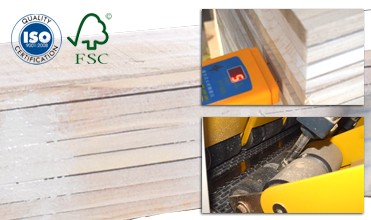
Quality Management
As an ISO 9001:2008 certified factory, we have the very strict quality management system, from the material wood selection to the final products quality , we always follow the standard processes for ensuring that each of the final boards and wood products can meet the wood industry standards and your special requirements.
Quality Control
MC Control: after the dying process, all of the final boards and products will up to the Qualified MC Grade,
Glue Requirement: E0, E1, E2, MR, WBP Phenolic, WBP Melamine or as Customized.
Dimensional Tolerance: by the most sophisticated equipment, the Length, Width and thickness of the boards and wood products can be produced with the very low level of the Dimensional Tolerance.


Head Rig
The primary saw cuts the logs into sawn pieces or boards,
Edging
Removes irregular edges and defects from sawn pieces or boards.


Trimming
The trimmer squares off the ends of lumber into uniform pieces.
Rough Lumber Sorting
Pieces or Boards are separated based on dimension and final product production, whether the finished pieces or boards will be unseasoned(kown as "green") or dry.


Stickering
Lumber destined for kiln drying production is stacked with spacers(known as stickers) that allow air to circulate within the stack(Green product skips this stage and the next).
Drying
Kiln Drying wood speeds up the natural evaporation of the wood's MC in a controlled environment.


Gluing
Gluing the side of the uniform pieces and Splicing them together.
Pressing
The Spliced pieces will be getting thought the pressing process for ensuring all the glued pieces be stable.

Sanding
Smooths the wood's surfaces and ensures that each boards or pieces has a uniform thickness, all the surfaces of the boards or pieces will be sanding by the airbag sanders with the sand belts of P60/P180/P240 or as customized(P60 belts can keep the wood grains well; P180 belts for the very smooth surfaces, P240 belts for the perfect surfaces applying to the printing process).


MC Test and Grading
Assigns a "grade" to each board that indicates its quality level, based on a variety of characteristics, including its MC.
Sealing and Storage
After Grading, all the Boards will be sealed and stored into the Finished Goods Warehouse.

Careful Packaging
Specialized Sealing Films are sealed on the six surfaces of the boards package.
Thicker Corrugated Papers are packaged Six-Sides for protecting all of the faces and angles.
Three/Five-Lays Plywood Boards are packed Six-Sides for resistance from outside.
Toughness Packing Belts are strapping strongly on the outside of the Package.
Stronger Wood Pallets at the bottom for making the Unloading easier for shipment receiving.
Fast Delivery
3 km distance of the national road from our Factory to the High-Way Entry.
30 container trailers or more we can arrange for the delivery.
500 km distance of the national high-way road from our factory to the Qingdao Port.
5 hours or less transport time, the cargo can be delivered to the Port for the shipment.


Over 25 years' professional experience of all kinds of wooden products
We are factory and direct marketing strategy with competitive prices


Over 110 technical staff and experienced workers guarantee high stable quality
Best Service with fast delivery and years of exporting experience
Paulownia trees are native to China and have long been introduced to Vietnam, Japan, and other parts of Asia. It has been distributed all over the world. Paulownia is one of the fastest growing fine tree species, good material, and widely used.
An important criterion to judge the quality of wood material is the bulk density and strength, the lighter the bulk density, the greater the strength, the wood material is good, and Paulownia belongs to high-quality medium and first-class wood. However, Chinese people generally like to use hard wood to make furniture, like the thick sense, so they do not like to use paulownia to make furniture in China. But paulownia, as a home and building materials, is widely popular and loved in Japan.
Paulownia wood wood characteristics
Paulownia wood ray is fine, the wood texture is straight, after planing silk luster, the material is soft and tasteless. Wood does not deformation and warping, moisture resistance, strong electrical insulation, low thermal conductivity, water resistance, corrosion resistance, wear resistance, beautiful texture bright color silk bright, beautiful, delicate texture, natural pattern is very good. The leading tone is strong, the paulownia is not easy to split but the wood is soft, easy to process, easy to carve and easy to dye. It has the advantages of smoke-proof, moisture-proof and not easy to be eaten by insects.
Advantages of paulownia wood
Paulownia wood has four advantages suitable for making furniture, that is, fast growth, wide distribution, good material and many uses. Here is an analysis for you.
Grow fast
If the management is good, five or six years can become a material, and the quote "three years into the forest, five years into the material" this common sentence illustrates its rapid growth. Moreover, it is suitable for the reasons of intercropping and its great effect on resisting drought, wind sand, dry hot air, frost and snow disasters in the morning and evening.
widespread
Its distribution range is very wide, 23 provinces, municipalities, autonomous regions have. It is especially pointed out that in recent years, many areas have planted paulownia in the four sides, and also engaged in intercropping and planting in the forest network of the square field, and some places have gradually developed to the mountain afforestation.
Good material
Because it is light wood, easy to process, bright and beautiful texture, not easy to warp fission shape, not easy to burn, good insulation sound performance, but also has the advantages of moisture insulation, corrosion resistance, easy to dry and so on. Therefore, it is not only used in industry, agriculture and daily life, but also our traditional export materials.
versatile
At that time, flowers can also be used as feed, fertilizer, and can also be used to trap pests; Its leaves, flowers, fruits and bark can be used as pharmaceuticals. The paulownia tree is beautiful, the flowers are colorful, and the leaves can purify the air. Therefore, it is not only an excellent timber tree species, but also a "medicinal tree species", "a good tree species for ornamental and industrial and mining greening", and has a certain role in plant protection.
Disadvantages of paulownia wood
Have no talent
The main disadvantages of paulownia should not be a large plate, paulownia is hollow in the middle, so it can only be a piece of board, and then pasted wood or processed into a joinery board to make furniture, with the general solid wood furniture feel different.
Too light texture
Paulownia furniture texture is very light, does not conform to the values of the Chinese people, the Chinese like the atmosphere thick.
The use of Paulownia
Paulownia wood texture is beautiful, after cutting the surface of the plate can show a kind of silky bright beautiful luster and strong three-dimensional texture. Moreover, paulownia wood has good stability, uniform structure and easy processing. In addition, tung wood moisture-proof insects, not easy to burn, easy to paint. Good acoustic performance, strong resonance, no matter how the climate changes, the sound quality can remain stable, so paulownia is a good material used to make Musical Instruments, known as "Qin Tong".
In addition to making furniture and Musical Instruments, Paulownes also have great uses in military and industrial aspects, due to the advantages of light moisture and not easy to burn, can be used to make aviation models, precision instrument shells, liner boards in passenger ships and buses, aviation and water transport boxes. The content of cellulose is high, the color of the material is light, or the paper industry is a good raw material.
Name: Yuna
Mob:+8613336214004
Email:yuna@jiusiwoods.com
Hot Tags: Paulownia Wood Panels, China Paulownia Wood Panels suppliers, manufacturers, factory, Paulownia S4S Board, Paulownia Wood Plank, Poplar Wood Panel, Paulownia Solid Wood Board, Oak Wood Panel, Paulownia Edge Glued Board


